BIOCLOVER · IRISH-GROWN ACTIVES
Skin Barrier Care
What the skin barrier does, why it matters across personal care, and how we test every BioClover ingredient with it in mind.
Why the skin barrier matters
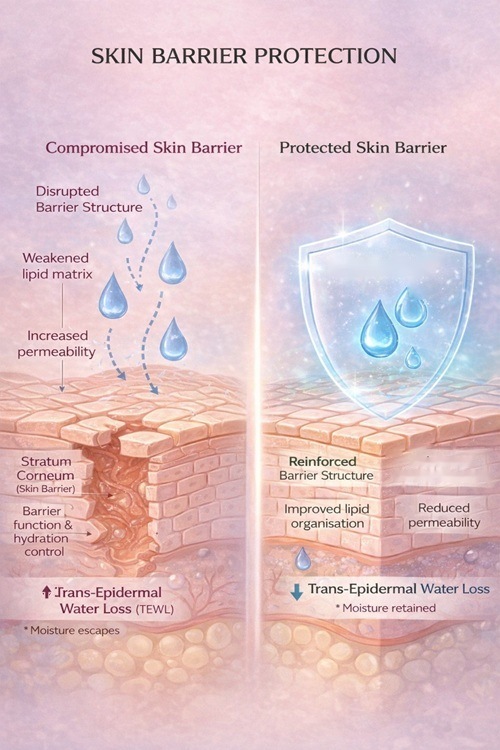
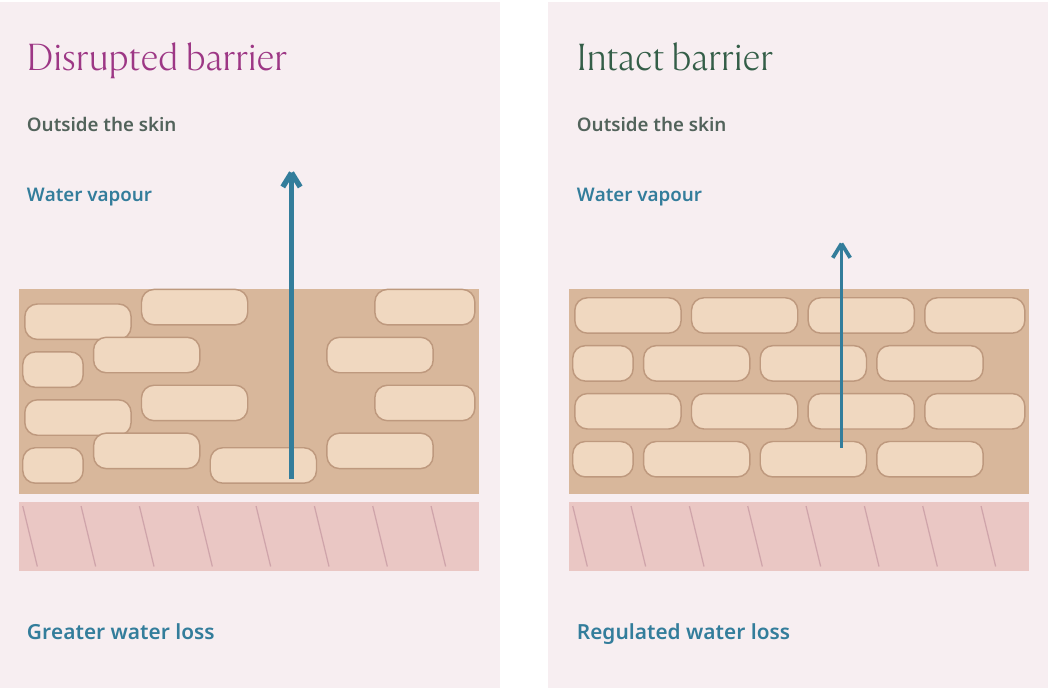
The skin barrier is the skin’s outermost defence: a layer of flattened cells held together by lipids such as cholesterol and fatty acids. It holds water in and keeps everyday irritants out. Weather, cleansing, pollution and lifestyle stress can all disrupt it – in skincare, body care and scalp care alike. When the barrier is disrupted, skin loses more water and feels dry, tight and reactive. Barrier-care formulation aims to support the skin’s natural defences and keep skin comfortable, hydrated and resilient.
In skincare
On the face and body, the barrier lives in the stratum corneum: flattened cells held in a lipid matrix of cholesterol, fatty acids and other structural lipids. When those lipids run low – through weather, over-cleansing or everyday stress – water loss rises and skin feels dry, tight and reactive. Barrier-care formulation works in two directions: limiting further water loss at the surface, and supporting the skin’s own lipid structure. Dermatology research consistently points to replenishing those physiological lipids as central to modern barrier care.
In hair and scalp care
The scalp is skin too, with a barrier of its own – and a comparatively weak one, with higher water loss than skin on the arm or back. A disrupted scalp barrier is linked with dryness, itch and flaking, and scalp condition is increasingly tied to the quality of the hair that grows from it. The hair fibre itself is different. It is not living skin, so it cannot rebuild itself the way skin does – but it has its own protective barrier: the cuticle, overlapping cells coated in a thin lipid layer that washing, heat and colouring gradually wear away. Fibre care protects and conditions that surface, while the scalp’s living barrier can genuinely renew. Barrier care in haircare therefore means two distinct things – looking after the scalp’s skin barrier, and protecting the fibre’s cuticle.
How we test our ingredients
Every BioClover ingredient follows the same testing pathway, from the field to independent laboratories.
1. Botanical characterisation
Each extract is profiled by LC-MS to identify its bioactive compounds, with total phenolic and flavonoid content measured. Completed across the range.
2. Antioxidant assays
DPPH and FRAP assays compare antioxidant activity between our botanicals and guide which combinations we develop. Completed across the range.
3. Skin-model testing
Reconstructed human epidermis (RHE) models measure water loss (TEWL) after an SDS irritant challenge and the irritation-associated marker IL-1α. Complete for our red clover extract; underway for the full range with MTU.
4. Safety first
Cell-viability screening checks each tested material is non-cytotoxic at the concentration used, before any performance reading is considered.
From our farm to your formulation.
Formulating for barrier care?
Tell us what you are developing and we will share specifications, samples and the compliance pack.